
Victor Wakefield, a 16-year Teach for America veteran, was appointed Nevada’s Superintendent of Public Instruction by Governor Joe Lombardo on September 29, 2025, became the state’s highest-ranking education official with authority over nearly 500,000 students, 30,000 educators, and a $6.6 billion department budget.
His rise to that position traces a path that reveals a broader — and largely unscrutinized — pattern of TFA alumni and executives cycling into Nevada’s education governance, creating persistent structural conflicts of interest that appear to violate state ethics law yet have never triggered a single formal complaint or investigation.
The most striking of these conflicts involves Wakefield: he served simultaneously as Teach for America’s Las Vegas executive director and Nevada State Board of Education member during 2015–2016, sitting on the very board that oversaw education policy and funding affecting TFA operations.
His then-wife, Alexis Gonzales-Black, held a State Board seat from 2012 to 2015 while Wakefield ran TFA-Las Vegas , an arrangement that a Las Vegas Review-Journal columnist flagged in January 2013 but that otherwise escaped public accountability.
Coming soon!
Today, we have the same problem: Tim Hughes, the current TFA Nevada Executive Director, simultaneously holds an elected seat on the State Board of Education.
Keeping it in the Family: When Your Wife is on the School Board that Pays Your Bills
The earliest and most clear-cut ethics concern centers on Alexis Gonzales-Black, a TFA alumna who won election to the Nevada State Board of Education’s District 1 seat in November 2012. At the time, she was working at Zappos and was married to Victor Wakefield, who had been running TFA-Las Vegas since 2011.
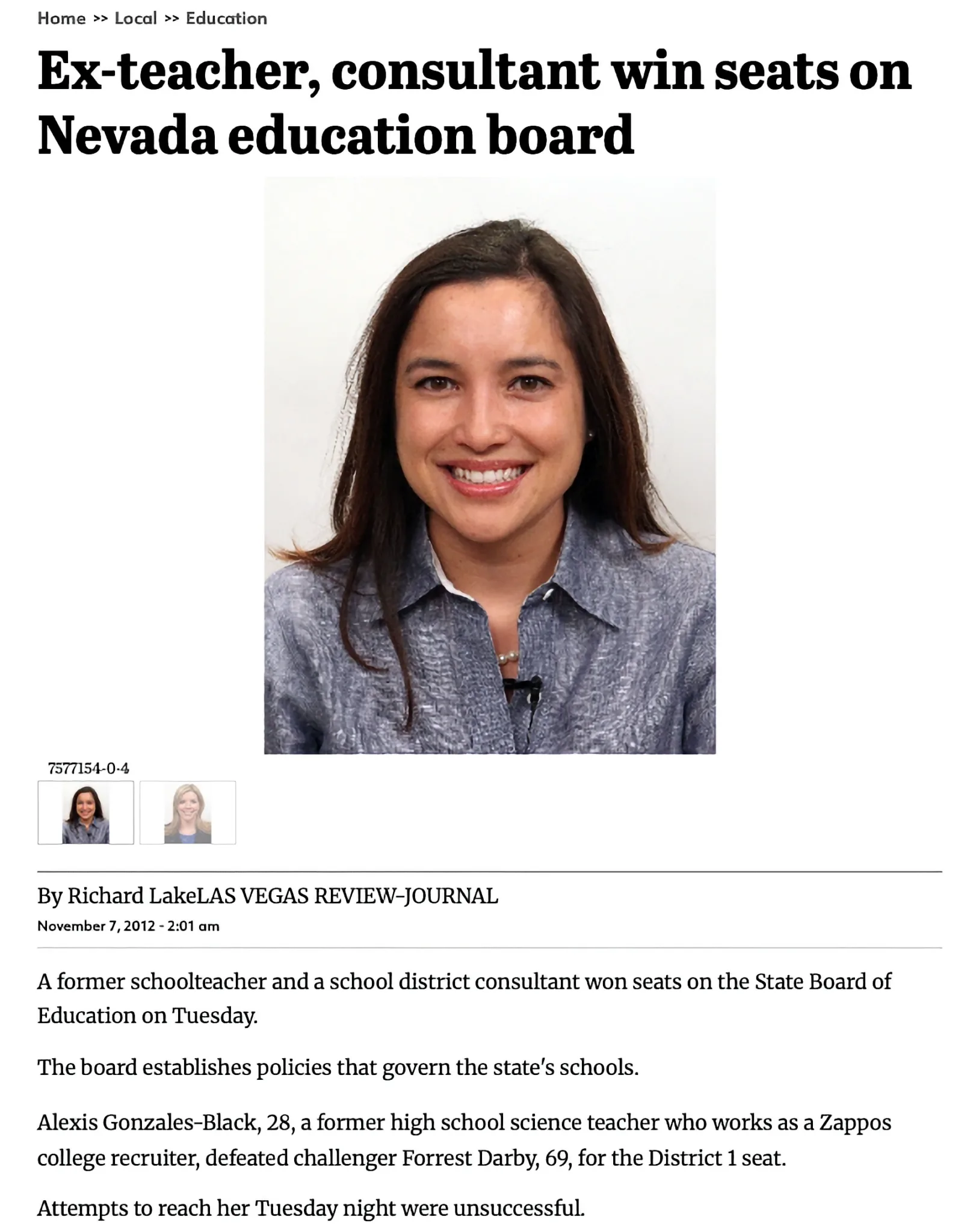
The financial stakes were significant. Governor Brian Sandoval allocated $2 million in state funds for TFA in 2013.
The Clark County School District renewed its TFA partnership for up to 150 teachers at $600,000 in April 2013, then approved a three-year contract for up to 525 teachers at a maximum cost of $2.1 million in December 2014.
Nevada’s ethics statute, NRS 281A.420, requires public officers to disclose conflicts and abstain from voting on matters where a spouse’s employment creates a “commitment in a private capacity.”
Under NRS 281A.065, a spouse falls squarely within this definition, Gonzales-Black’s husband ran the local chapter of an organization receiving millions in public funds that the State Board had policy oversight over.
A reasonable person in her position would have had their independence of judgment materially affected on any TFA-related matter.
Yet no public record exists of Gonzales-Black ever recusing herself from TFA-related votes, disclosing the conflict on the record, or being asked to do so. No ethics complaint was filed with the Nevada Commission on Ethics.
The only public mention of the arrangement came in a January 2013 column by LVRJ journalist Jane Ann Morrison, who noted that Gonzales-Black “was particularly pleased about the additional funding for Teach for America because her husband, Victor Wakefield, runs Teach for America in Las Vegas.”
A March 2014 post on education historian Diane Ravitch’s blog, written by Nevada teacher Angie Sullivan, asked pointedly: “Hundreds of thousands of campaign dollars spent on unpaid board seats, one has to ask… why?” Neither observation triggered any official response.
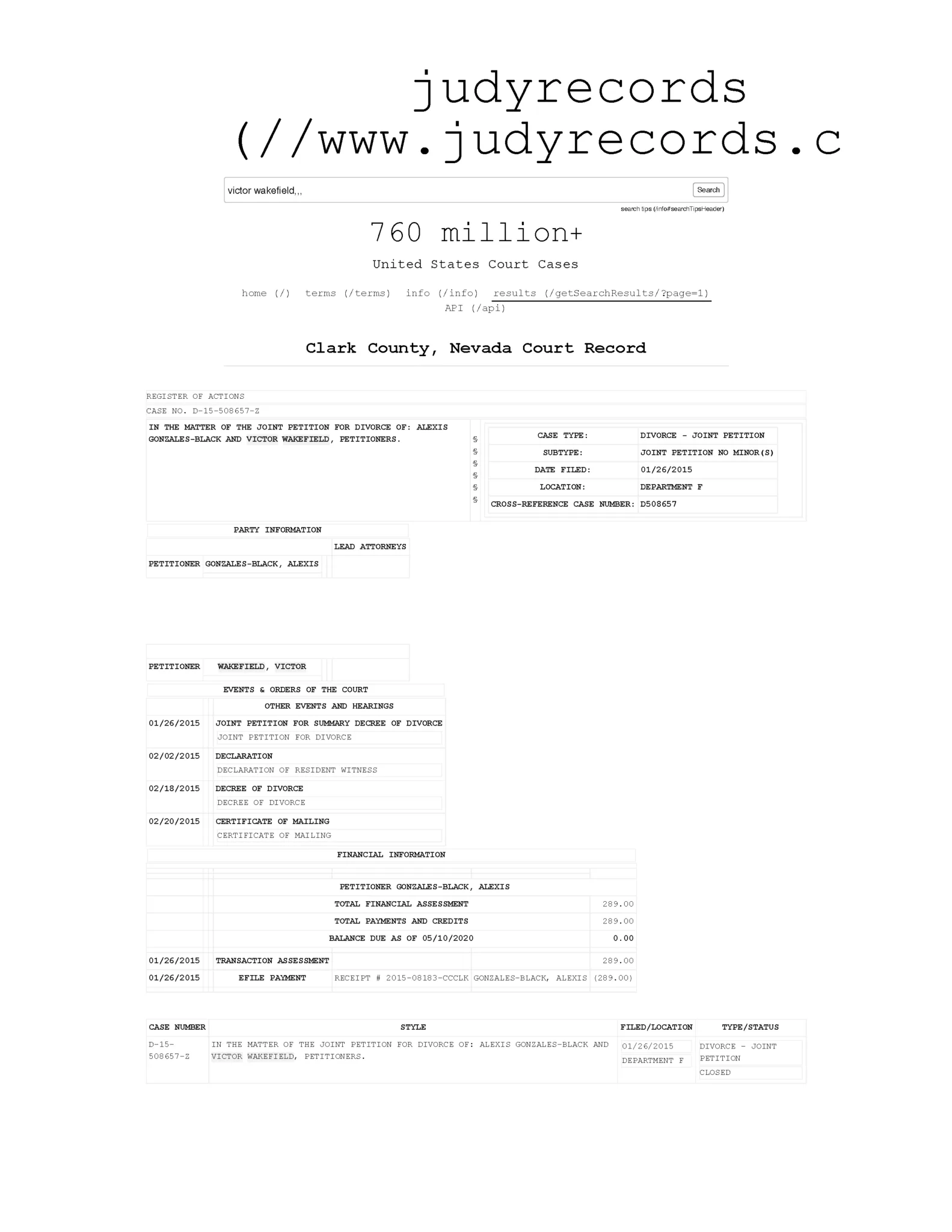
The couple filed for divorce in January 2015 and received a decree in February. Gonzales-Black resigned from the board in April 2015, relocating to California to launch a consulting business.
State Board meeting minutes from 2012–2015 are not readily accessible online, meaning a definitive accounting of whether she voted on TFA-related matters would require a public records request to the Nevada Department of Education.
Wakefield’s overlapping roles raise the same questions
After Gonzales-Black’s departure, Governor Sandoval appointed Wakefield himself to the state board’s district 1 seat, where he served from 2015 to 2017.
Multiple sources, including the governor’s own 2025 press release and Wakefield’s LinkedIn profile, list his TFA-Las Vegas Executive Director role as running from 2011 to 2016. The Las Vegas Sun’s September 2025 profile places the end date at 2015.
Either way, there was a confirmed overlap period during which Wakefield simultaneously led TFA-Las Vegas and sat on the State Board of Education.
This is the identical structural conflict that his ex-wife’s tenure presented, with one critical difference: Wakefield wasn’t merely married to a TFA executive, he was the TFA executive.
His own career advancement, professional reputation, and organizational success were directly tied to TFA’s performance and funding in Nevada.
During his Board tenure, he participated in significant votes, including being the lone dissenter in a 6-1 decision on charter school takeovers in December 2016, and voting unanimously with the board to approve CCSD reorganization regulations in September 2016.
No public reporting from 2015–2017 examined whether Wakefield recused himself from any matter affecting TFA.
No ethics complaint was filed.
His application packet for the superintendent position lists his prior board accomplishments, overseeing Zoom Schools and Victory Schools funding, setting CCSD reorganization regulations, and serving on an education professional development task force, never once bringing up how he attempted to avoid conflict of interest or other ethical concerns.
The career that led to superintendent
Wakefield’s full career trajectory illustrates how deeply embedded in TFA’s institutional structure Nevada’s current education chief has been. He holds a bachelor’s from Princeton (2007, History/American Studies), a master’s from Dominican University (2010, Elementary Education), and a doctorate from Johns Hopkins (2020, Entrepreneurial Leadership in Education).
His 16-year TFA career spanned increasingly senior positions:
- Middle school teacher in Gary, Indiana (2007–2009)
a TFA corps placement - Director of Recruitment at Duke and Princeton (2009–2011)
- Executive Director, Teach for America in Las Vegas (2011–2016)
increased number of TFA teachers hired by Clark County School District from 90 to 250, increasing TFA revenue from $2 million to $5 million annually - National Vice President for Teach for America (2016)
supervised 16 regional divisions - Vice President for Special Projects (through 2025)
responsible for the policy priorities of TFA nationally, a $250 million+ organization with 4,000 member teachers impacting 300,000 students
Between TFA roles, he served as a senior fellow at the Kenny Guinn Center for Policy Priorities (2017–2020), where he led education policy advocacy including for SB 178, which allocated $72 million for weighted student funding. He also taught as adjunct faculty at Johns Hopkins and chaired the Board of TFA DC/Virginia.
The superintendent selection process began after Jhone Ebert left the position in April 2025 to become CCSD superintendent. The State Board received 19 applications, interviewed six semifinalists, and unanimously recommended Wakefield as one of three finalists. Governor Lombardo selected him, and he started on October 27, 2025, at a salary estimated at roughly $145,000 based on the most recent publicly available data. Coverage of his appointment was uniformly positive across Nevada media outlets; not a single outlet mentioned the prior Gonzales-Black conflict, Wakefield’s own overlapping roles, or any ethics concerns related to his TFA tenure.
A pattern that keeps repeating itself
The Wakefield-Gonzales-Black situation was not an isolated incident but the first instance of a recurring pattern in which TFA alumni and employees have moved into Nevada education governance positions with direct oversight of the organizations that employed them.
Allison Serafin, another TFA figure, served as Executive Director of TFA-Las Vegas, then became a special consultant to the CCSD Superintendent, then won election to the State Board of Education where she served as Vice President. She resigned from the Board in December 2015, citing potential conflict of interest, before bidding on and winning a $10 million state contract through SB 491 for her new nonprofit, Opportunity 180, which recruited charter school operators to Nevada. One operator Opportunity 180 brought in, Celerity Educational Group, had its conditional approval withdrawn after federal authorities raided its Los Angeles headquarters.
Tim Hughes represents the most current and most brazen iteration of the same conflict. A former TFA Vice President who later became TNTP’s Vice President for the West region, Hughes won the State Board District 1 seat in 2020. receiving a $1,000 donation from Leadership for Educational Equity, a TFA-affiliated nonprofit, while employed by TNTP, which held active contracts with CCSD including a U.S. Department of Education SEED Grant. In October 2024, Hughes was named Executive Director of TFA Nevada. He continues to serve on the State Board simultaneously. TFA’s own website openly describes him in both roles. No media outlet has raised ethics concerns about this arrangement.
Adam Johnson, a former TFA Managing Director in Las Vegas, ran for CCSD’s Board in 2016, raising $48,216 in contributions while still employed by TFA. He lost that race but was later appointed as a nonvoting CCSD Board member by the Las Vegas City Council in October 2023 under AB 175. He is set to gain voting rights in 2027.
The donor network behind the board seats
The financial architecture supporting this pipeline warrants scrutiny. Gonzales-Black and Serafin’s 2012 State Board campaigns reportedly raised a combined $300,000, an extraordinary sum for unpaid board seats, with heavy contributions from Elaine Wynn (billionaire casino mogul, co-founder of Wynn Resorts, and later appointed State Board President by Governor Sandoval) and Tony Hsieh (late Zappos CEO, who also employed Gonzales-Black and designated $50 million in Downtown Project funding for education initiatives).
Wynn served as State Board President for roughly eight years under multiple governors, during which time she publicly advocated for TFA and championed education reform initiatives closely aligned with TFA’s mission.
The Elaine P. Wynn and Family Foundation directly supported TFA. This created a governance structure in which the Board President was a major TFA donor, multiple Board members were TFA alumni or spouses of TFA executives, and TFA was simultaneously receiving state and district funding subject to Board oversight.
The TFA-affiliated Leadership for Educational Equity (LEE), a 501(c)(4) with over 30,000 members, has specifically supported TFA alumni running for education governance positions. LEE donated to Hughes’ 2020 campaign and has received funding from figures like Michael Bloomberg ($220,000). LEE’s explicit purpose, placing TFA alumni in positions of political power, makes the pipeline not merely incidental but institutionally deliberate.
And they shrugged, or no one reallay noticed
Nevada’s ethics enforcement framework contains structural weaknesses that help explain the persistent lack of accountability.
The Nevada Commission on Ethics can receive complaints and issue advisory opinions, but advisory opinions requested by the subjects themselves are confidential unless the requester waives confidentiality.
This means it is theoretically possible that Gonzales-Black, Wakefield, or Hughes sought guidance privately. But, any such guidance would be invisible to the public.
More fundamentally, Nevada’s part-time legislature and historically weak ethics enforcement create an environment where conflicts persist unchallenged.
When Assemblywoman Michelle Gorelow voted to appropriate $250,000 to Arc of Nevada through the 2023 “Christmas tree bill” (AB 525), the same bill that gave TFA $25,000, and was then named its executive director a month later, the Legislative Counsel Bureau ruled that legislators with family connections to recipient nonprofits did not have a disqualifying conflict because the appropriation was of “immense public importance.”
This ruling illustrates the permissive interpretive framework that has allowed similar conflicts in education governance to go unaddressed.
The media environment is equally thin. The Las Vegas Review-Journal, Nevada’s largest newspaper, is one of the only consistently-nvestigative outlets over the last decade.
The Nevada Independent and Nevada Current are relatively young outlets. Jane Ann Morrison’s 2013 column and Angie Sullivan’s 2014 blog post on Diane Ravitch’s site remain the only public documents specifically naming the Wakefield-Gonzales-Black conflict, and neither triggered any follow-up investigation, editorial response, or formal inquiry.
How can you have conflicts of interest with friends like these?
Wakefield now holds a position with direct authority over educator licensure, distribution of state and federal education funds, accountability systems, and regulatory oversight of all Nevada K-12 schools — including any programs or partnerships involving TFA.
While he is no longer a TFA employee, his 16-year institutional relationship with the organization, his ongoing network connections, and his former role as Board chair of TFA DC/Virginia raise legitimate questions about impartiality.
Tim Hughes, Wakefield’s successor as TFA-Las Vegas leader in a sense (as current TFA Nevada ED), sits on the state board that recommended Wakefield unanimously for the superintendent position and now serves as the body he reports to as secretary.
Since taking office, Wakefield has focused on literacy improvement, college and career readiness diplomas, chronic absenteeism, and educator workforce shortages. He has drawn no direct public criticism. A Washoe County special education funding dispute inherited from his predecessor was resolved amicably. His policy priorities appear substantive and widely supported.
Cat got your tongue? More like a systematic pattern of organizational capture.
The investigation reveals not a single dramatic scandal but something potentially more consequential: a systematic pattern of organizational capture. One nonprofit, Teach for America, has placed alumni and executives across every level of Nevada’s education governance over more than a decade, from the State Board of Education to the superintendent’s office, while simultaneously receiving millions in public funding subject to oversight by those same individuals.
The relevant ethics statute, NRS 281A, clearly requires disclosure and abstention in these situations, yet no evidence of compliance — or enforcement — exists in the public record.
The absence of formal complaints does not indicate the absence of conflicts. It indicates the absence of accountability infrastructure capable of identifying and addressing them.
The fact that Tim Hughes can openly serve as both TFA Nevada’s Executive Director and a State Board member in 2025–2026 without triggering any public ethics review suggests that the pattern documented here is not merely historical but ongoing and institutionally normalized.
Whether Wakefield can exercise independent judgment as superintendent after spending his entire professional life within TFA’s orbit is a question that Nevada’s governance structures appear neither designed nor motivated to ask.


Leave a Reply